
During our summer holiday this year, we visited Gross Arnold’s hometown of Turda (Torda) with the whole family. We spent a day in the charming town and met Gross Arnold’s friends who live there, Éva Amirás and the Keszeg family. The memories are made even more vivid by an interview recovered from the estate, which Arnold recorded in Budapest back in August 1971 with his father, Gross Károly of Torda, about the old days and memories of Turda. On the worn cassette tape, Arnold asks his father about his memories of Turda and Oradea (Nagyvárad); his father tells his stories gladly and at length, though Arnold, of course, keeps interrupting, so we never get to hear the end of every story.
The Gross family in Turda, 1930 / Arnold and his brother, Tivadar / The swing in the garden in Turda

Arnold’s parents, Gross Károly and his wife, Ilona Kovrig, moved in 1925 to Turda, a town 30 km from Cluj-Napoca (Kolozsvár). Until 1940 the family lived in the house at what was then 5 Fazekas Street — today Strada Crisan 5. It was here that Gross Tivadar was born in 1927, followed by Gross Arnold in 1929. The neighborhood was home to well-to-do craftsmen, joiners and merchants; the mayor’s house stood a few doors down, and a little further up began the row of villas belonging to the truly wealthy. Among them was the villa of Ilona’s brother, Károly Kovrig, an official at the Turda cement factory. The three-room house on Fazekas Street, with its veranda and garden, had previously belonged to a mason, who had built it himself, like the other houses on the street. The glazed veranda on the inner side of the street-facing front half of the building became the studio of Arnold’s father, who supported the family by painting signs and devotional pictures — hence the inscription Pictura visible on the gable in the photograph. At the time this counted as a highly respected, well-paying trade: they were able not only to buy a decent house with a garden, but to extend it right away. His wife, too, worked as a clerk at the local cement factory, which was under French ownership.
The Gross family in Turda, in front of their house at 5 Fazekas Street, around 1932
In their family home in Turda, works of art — panel paintings and devotional images, portraits, landscapes and still lifes — along with brushes, tubes and jars of paint, were as natural a part of life as the ever-moving swing, the kaleidoscopes hidden in the grass, the tamed rocking horse or the lead soldiers lined up in battle order. Crucifixes made to order dried in the chamomile-scented air in the yard of the veranda-fronted house overgrown with wild vine. It was from the fragments of this wonder-filled realm that the universe which became Gross Arnold’s trademark was later born. With his father and brother he made shorter and longer creative excursions every day to the Turda Gorge (Tordai-hasadék) and along the Arieș (Aranyos) valley to spy out the secrets of nature. While their father painted, he sat in the grass trying to capture the details of the landscape in pencil and watercolor. The forest, the stream bank and the meadow became his familiar, everyday surroundings, and this closeness to nature fundamentally shaped his entire later oeuvre.

The garden and the swing in the 1930s. On the left, the entrance to the rear apartment; in the middle, the iconic swing frame, which would later appear in countless Gross works; on the right, the glazed veranda of his father’s studio.
The two-room apartment at the rear, facing Potaissa Street, was built by Gross Károly and his family, as the previous tenant went on living for a while in the three-room apartment fronting Fazekas Street. The house was thus divided into two apartments, and the rear one was later rented out.

According to Károly, at the invitation of Gyula Kovrig — Ilona’s other brother, who was a Catholic priest — the writers Áron Tamási and Jenő Dsida also came to the family for several visits and lunches. This is attested by one of Dsida’s letters, sent to Károly Kovrig and kept today by Ádám Kovrig Nagy in Szeged. The letter was published in the journal Forrás.
The house as it stands today, seen from Strada Crisan.
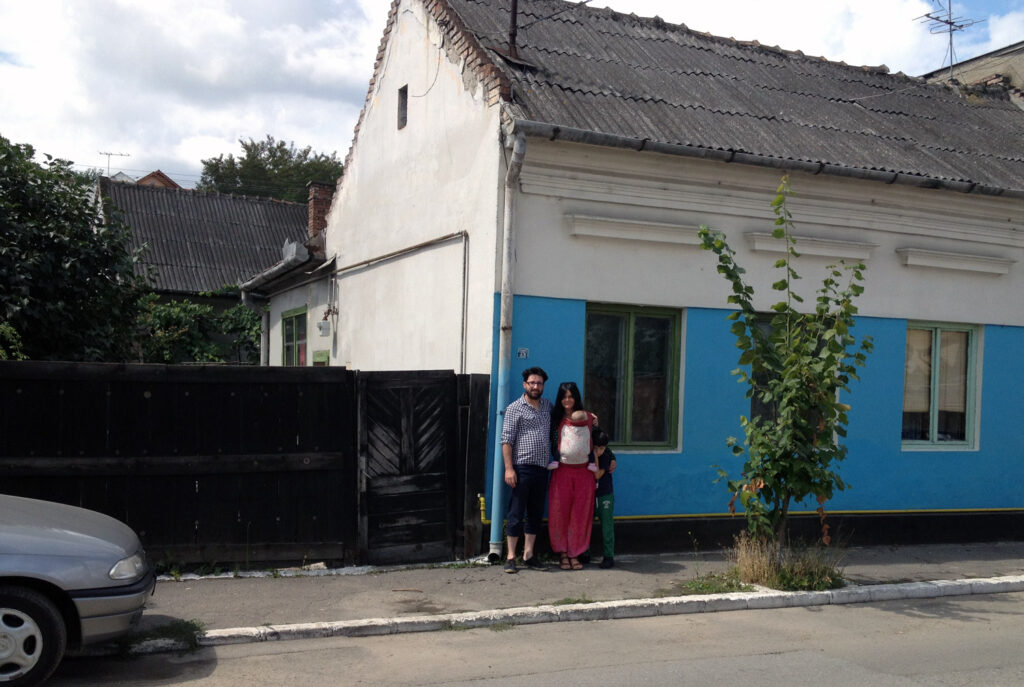
In the courtyard of the house with Vilmos Keszeg. Sadly, the glazed veranda of the studio has since been walled in, and the garden has been built over.


Arnold immortalized the house of his birth in the etching Studio in Turda I (Tordai Műterem I.). On the left is the studio, in the middle the swing, on the right the fence, and behind it the building of the Lyceum.
“For me, as for many other natives of Turda who have moved away, the memory of the town has stayed with me with great force. There were celebrations and parades in the town center, and very beautiful shop windows in those days. Even the cakes in the pastry shop were beautifully made. And the pencil shop sold pretty pictures, transfer pictures. As I remember it, in Turda I was surrounded by a richer, cleaner, more cultured atmosphere. Somehow the town, in its scale, grew to fit me. I am not saying I feel bad in Budapest. But somehow I always longed to come back here. I had an acquaintance, András Keszi-Harmath, who came home from Switzerland and kept writing to me about Turda, about what a beautiful town it is. And it really is very beautiful. I say that sincerely. Its scale, with its little houses — I felt good here. I am always glad, and always recharged, when I can take a little walk in the town and look at the streets. My father was a painter here. We had a house that was like a studio, where I too learned to draw. We were just inside that little house — it no longer has a garden, it has been built over. And it seems so aged now. There were houses with big gardens on the street. Now they have all been built over. János Székely is a very dear writer. My father taught him to draw in Turda. He wrote in a letter about the scent of chamomile in the street.” – Gross Arnold

Sadly, the garden has been built over, but the Lyceum building can still be seen today, 2016. Photo: Gross András

Arnold met Vilmos Keszeg, professor and head of the Department of Hungarian Ethnography and Anthropology at Babeş-Bolyai University in Cluj-Napoca, in the early 1990s, after the Romanian revolution. From then on they met often — sometimes in Budapest, sometimes in Cluj-Napoca, sometimes in Turda. Part of their conversations was always captured by a running tape recorder. A longer version of the published selection from these conversations, conducted over many years between 1992 and 2009, appeared in the November 2009 issue of the Cluj-Napoca journal Korunk.
In 1992 Arnold handed over to Vilmos enough etchings for a whole exhibition; from these, shows opened in Cluj-Napoca in 1992 and 1994, in Sfântu Gheorghe (Sepsiszentgyörgy) and Turda in 1992, in Târgu Mureș (Marosvásárhely) in 1993, in Turda in 2002, and in Oradea (Nagyvárad) in 2006. The Korunk Gallery in Cluj-Napoca hosted the pictures in July 1995. Gyöngyi Orbán paid tribute to the artist in the Transylvanian journal Művelődés (XLIX, 1996/1), as did István Berszán in Korunk (VI, 1995/10). In 2009, on Vilmos Keszeg’s initiative, his native town of Turda made him an honorary citizen.
Three fine small etchings from this exhibition material have now returned to the gallery; after reframing, we will put them on show again in Budapest in August.

Vilmos and his family came across it by chance at a street clear-out, and they keep it to this day: the little double Thonet children’s chair from the 1890s that Arnold and his brother Tivadar used back in the 1930s. The bentwood beech piece has kept its mischievous little slant to this very day…

Unfortunately the sky clouded over at just the wrong moment, so we could not visit the Turda Gorge, where the family went on so many outings in the old days; instead, we visited the famous Turda Salt Mine.
Our thanks to Éva Amirás and the Keszeg family for their kind hospitality and guidance, and for sharing their memories.
2017, Gross András