
In the 1950s, Gross Arnold spent many a summer at Lake Balaton.
His etchings entitled Badacsony and Balaton are among his best-known and most beautiful works.
On this year’s holiday at Lake Balaton we too sought out the places where these works were born, and we share a few interesting details from an interview recorded in 2015 with Arnold’s college classmate, the graphic artist Töreky Ferenc, who passed away last year, in his studio, in which he shared with us their friendship and their experiences together.
Töreky Ferenc in his studio in 2015, photo: Gross András
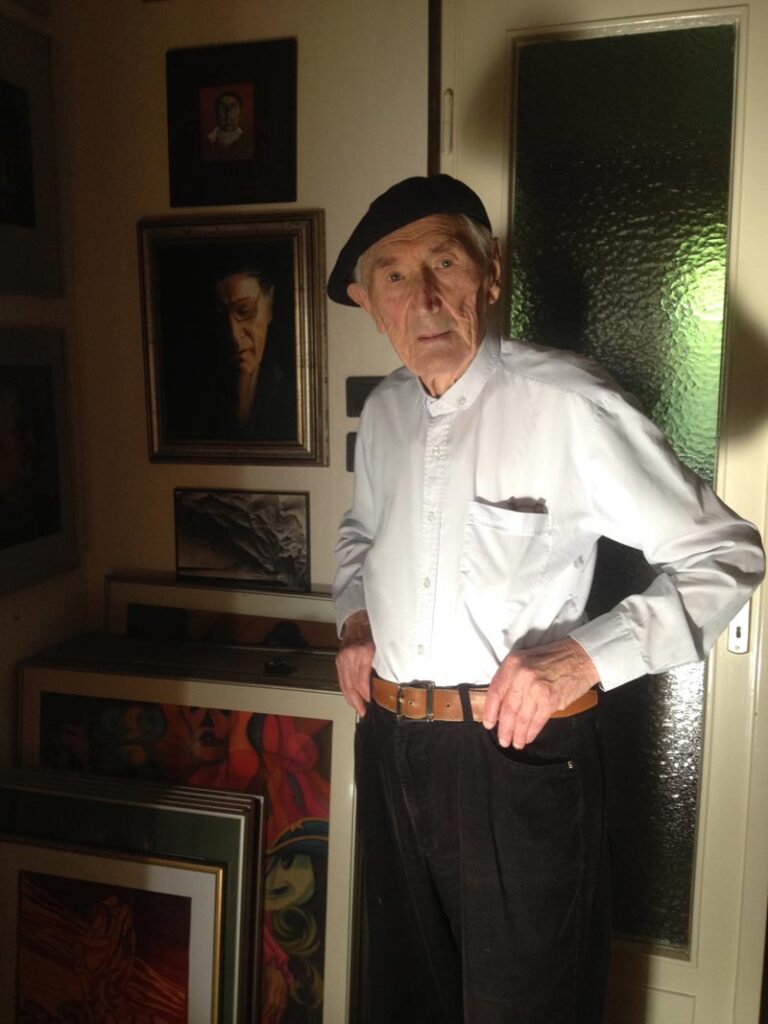
Töreky Ferenc was born in 1922 in Nemesvita, near Balatonederics, where his parents lived and farmed. He entered the Academy of Fine Arts in 1947, after seven years as a schoolteacher, joining Koffán’s graphics class.
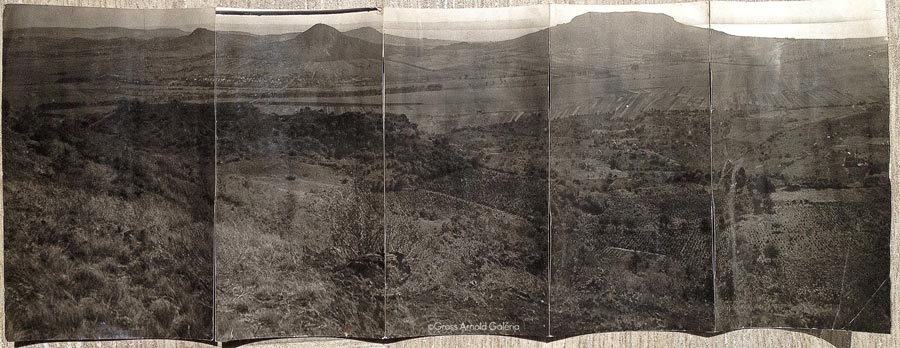
In the 1950s — still before nationalization — a small house stood in their vineyard on Becehegy, and his fellow students on summer holiday slept in its hayloft. Gross Arnold also stayed here several times, along with their classmate Csohány Kálmán (1925–1980), among others. They went on many excursions in the area, often visiting Keszthely and Szigliget, and he drew with Töreky and Csohány at the forest’s edge on the outskirts of Nemesvita. Arnold loved photography and took a number of photographs and panoramic pictures here.
View from Szent György Hill – panoramic photo: Gross Arnold, 1950s
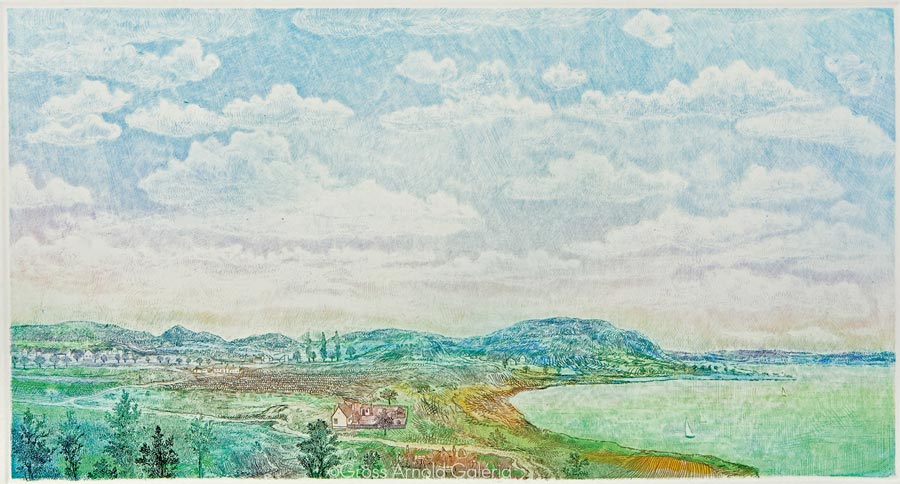
Gross Arnold – Clouds over Balaton (Balatoni felhők), colored etching, 1955
His pictures Badacsony and Clouds over Balaton were also made here, from the lookout at Bece, with a view of Szigliget Castle and Badacsony, and the Tapolca Bay in the foreground.

The work entitled Badacsony had an earlier version: on the left of the original composition, a lady sits beneath two trees, looking not at the landscape but toward the artist, with freshly picked flowers in her hand. The figure was presumably Mohos Piroska, a costume designer and Arnold’s sweetheart at the time. For reasons unknown, the artist later cut this section off the copper plate, and the new composition focuses on the landscape alone. Prints of the etching with the original composition have also survived, but they are relatively rare; we know only of impressions printed in black.
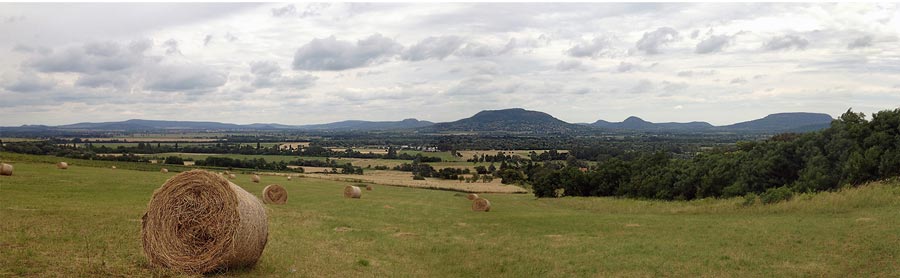
View from the outskirts of Nemesvita, 2016, photo: Gross András
Alongside the well-known Balaton subjects, the sources also mention several previously unknown works that came to light during our research. I am not certain whether these are the same work under different titles, or whether they exist as separate works: at the 1954 Hungarian Small Sculpture and Graphics Exhibition held at the Ernst Museum, Gross Arnold showed an etching entitled Excursion to Szigliget (Szigligeti kirándulás, 1954), and there is also the work View from the Castle Hill of Szigliget (Kilátás a Szigligeti várdombról), made in the same period, for which he was awarded the third grade of the Munkácsy Prize in 1955. The works probably went through several modifications and changes of title. In those days, the jury of the Fine Arts Fund also had considerable say in how the works took shape. Thus, in line with the jury’s decision, the landscape entitled Summer Afternoon (Nyári délután), also made in this period, was cropped: the jury members permitted the reproduction of the sheet only with the church tower on the side of the picture and the angel in the upper corner removed. A few prints of this etching with the original composition have nevertheless survived.
View from Szent György Hill, 2016, photo: Gross András

Searching for the original vantage points of these compositions, we ourselves took great pleasure in discovering the beautiful landscape of the Balaton Uplands around Nemesvita, Becehegy, Szigliget, and Szent György Hill.
Gross András, July 19, 2016