
The main theme of our conversation is friendship, so I would like to ask you about your friends — more precisely, about the friendship between you and Béla Kondor.
It is not easy to talk about this. After 23 years, pinning down and recording the facts is a very difficult task. Our friendship began back at the academy — a laughing-together, seemingly unserious friendship. What bound us together above all was that instinctive laughter, bitter yet liberated, which sprang from our inner sense of standing apart. I think our outspokenness, open or veiled, may also have been the reason why later on both of us, despite our artistic successes, remained on the outer rim of the art world. Throughout our whole careers this condition created a shared perspective for us.
Kondor drew the drama of a stern, somber world, while I created a rather “unsombre” world in my works. Between Kondor and me there was no great soul-baring friendship of that kind. I was his admirer. With his angels and his crucified Christ he conveyed to our century the cataclysms pointing from the past into the future — something which, in the visual arts, has to this day been shown with such crystal clarity only by Béla Kondor. The world of Kafka and Attila József, the changed times, are present in these Kondor impressions in their deepest form.
Béla Kondor at Gross Arnold’s home, 1953; in the background, a painting by Vladimir Szabó
With his depiction of man he gave form, throughout his life, to the human tragedy of Madách. What Madách condensed into a single work, Kondor depicted continuously across his entire oeuvre. Fortunately, Béla Kondor had already acquired, in his academy years in Károly Koffán’s class, a mastery of drawing that filled everyone with admiration, and he perfected it through Barcsay’s anatomical studies. In his final year at the academy he lived with me on Király Street. I keep many photographs from that time. It was then that he married Ági Kaufmann, who was also a sculpture student at the academy.
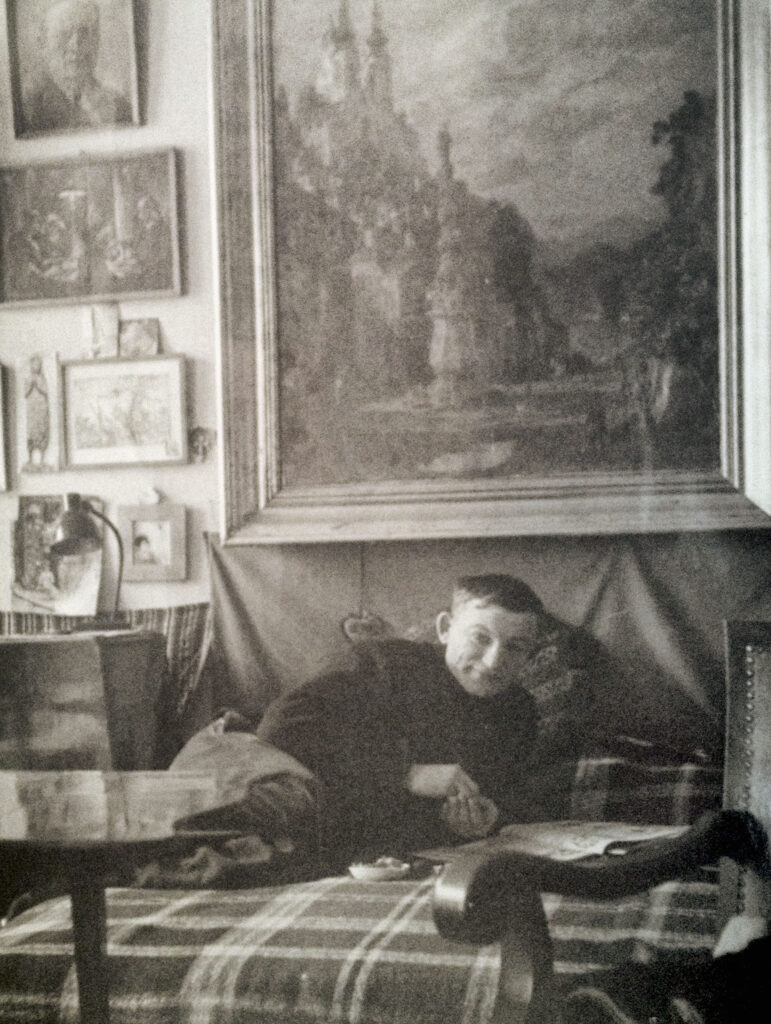
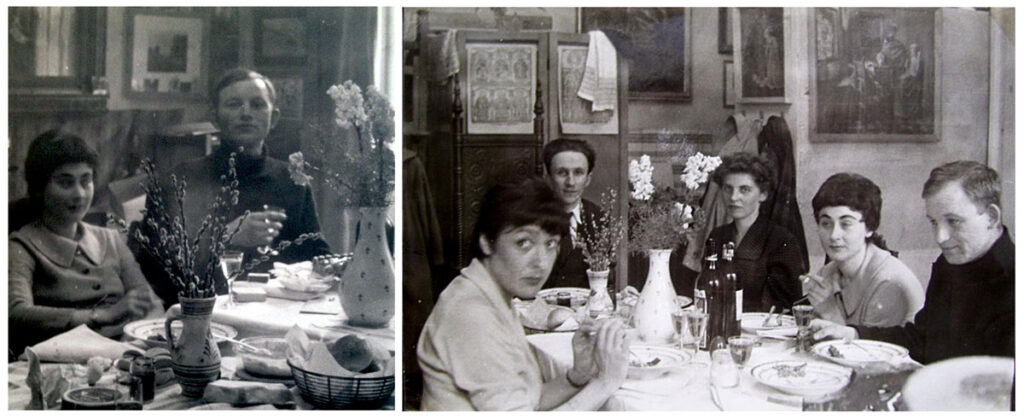
But besides them, Koffán, Kálmán Csohány, Vladimir Szabó and many others used to come up to my place. What I meant to Kondor, I can never know now. Nor can I put into words exactly what this friendship meant to me. But look around the apartment and you will see. After the white marble tombstone worthy of him was erected in the cemetery, I found the small wooden cross with plastic lettering, his grave marker, that had been put up at the time of his burial. I am keeping it in my apartment until a Béla Kondor museum opens. The photograph you see there was taken by Edit Molnár. I placed the photograph of Kondor with his face covered at the center of a glass picture of eclectic form.
The wedding lunch of Ági Kaufman and Béla Kondor at Gross Arnold’s home
What did inner detachment, an independent intellectual existence, mean in those days?
I entered the Academy of Fine Arts in 1949, into Károly Koffán’s class. But let me read to you from a speech my fellow artist András Csanády gave in 1991 in Szarvas, at a meeting of the Society for Archaeology and Art History, because I feel it bears closely on your question: “In the Academy’s new-fangled, squared-off, soldierly order, printmaking was not an independent department; it could be studied only as a supplementary subject with Koffán, in one or two afternoon classes a week. In time it became a refuge. Exceptionally, one or two students were permitted to take it as their major… I was perhaps the third to end up there; shortly after me came Gross and Würtz, then Gácsi, and then several others: we grew into a regular class.
We had a wonderful time with Koffán. We could work as we pleased, protected from all the stupid disciplinary rules and political lying that made work and life a misery in other classes. And Koffán, with his corrections, helped our work superbly. All the while I knew (we knew?) that he himself was incapable of working — instead he went birding. By then this had become his main occupation, and he carried it to the same perfection as everything else he touched.
Then Kondor arrived in our class. I believe it was in 1953 — the year Gross, Würtz and I received our diplomas. Koffán recognized very quickly what had come into his hands. He grew more and more infatuated with Kondor — quite understandably, for Kondor was capable of accomplishing anything, whatever task was devised for him. Among the teachers, Koffán supported the reform movement taking shape among the students most resolutely, and so it was in him that the students placed their trust, to him that they clung most of all. Kondor, meanwhile, worked hard: he made his diploma work, the Dózsa series, in the 1955/56 academic year and presented it to enormous acclaim. Then came October. Fortunately Kondor was not at home — he was doing his military service somewhere in the back of beyond, in Nagyatád — so Koffán could not drag him along into his revolutionary adventure and despair. After November 4 the Russians stormed the Academy, met armed resistance, and killed four of the fleeing students. Koffán once again felt responsible — but now far more concretely and personally than in the Stalinist years. Art was erased from his life for a long time; he could barely even exist. It was his birds, and Kondor, that gave him something to cling to, spiritually, at the edge of the abyss…
He was a frequent visitor to Kondor’s studio on Bécsi Street. In those post-revolutionary years he and Lajos Németh drew close to each other; Németh — having recognized Kondor’s talent — all but claimed him for himself as an art-historical subject. The two of them were steadfast comrades-in-arms in the battle that had to be fought for Kondor’s official recognition, while at the same time they also competed a little with each other for Kondor’s friendship. In that circle, however, they had to learn to accept and respect one another.
Then Kondor died. Not suddenly, and yet shockingly. With his unbridled pace of life he had burned through all his energy, all his reserves. He left a great void behind him — not only because his work was cut short, but also because the circle of friends that had surrounded him fell apart; as it now turned out, he alone had held it together.”
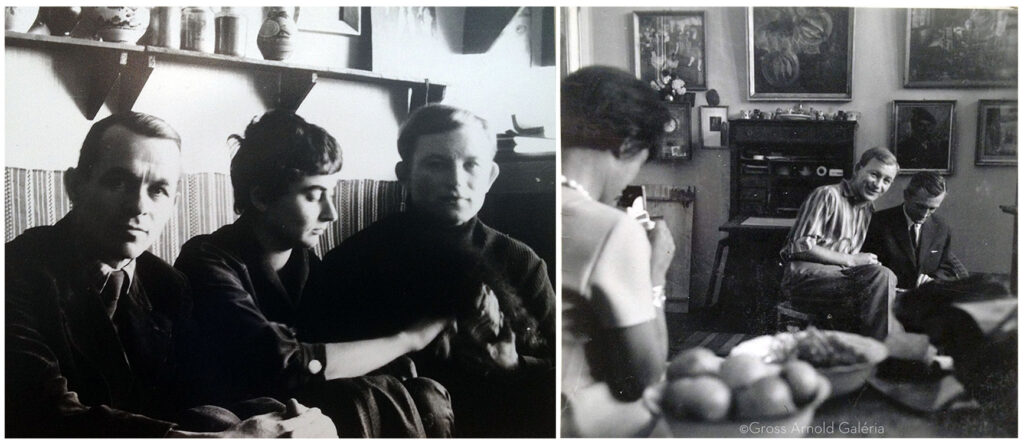
Károly Koffán, Ágota Kaufman, Béla Kondor – photo by Gross Arnold / Edit Molnár, Béla Kondor, János Pilinszky in Gross’s studio, photo by Gross Arnold
You also immortalized your friendship with Béla Kondor in your artistic oeuvre. Please tell us about this.
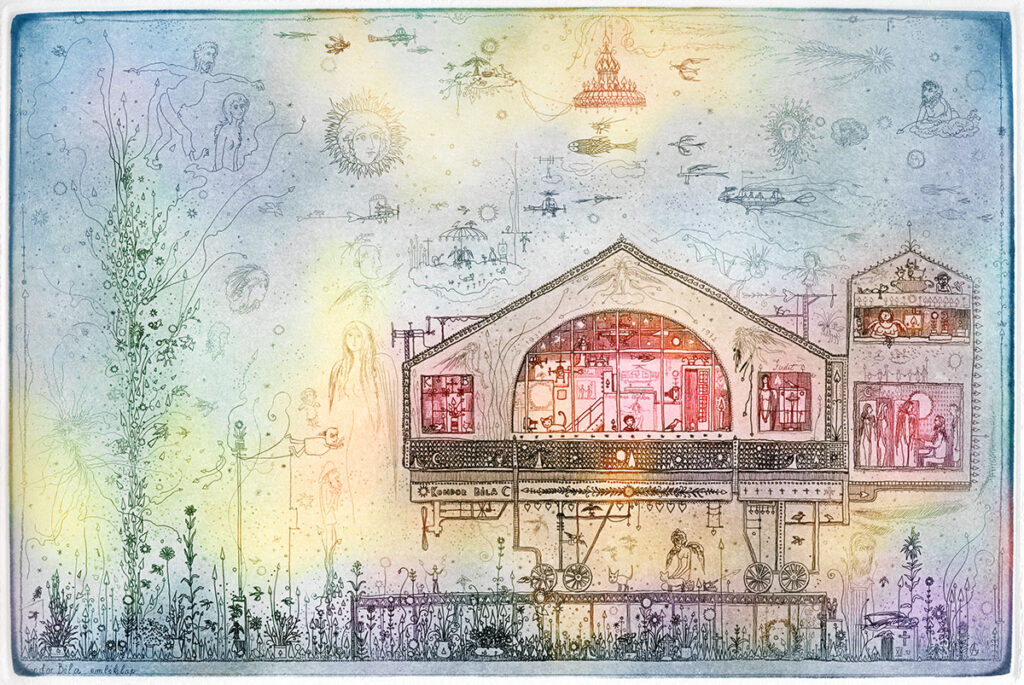
I made this commemorative print after Kondor’s death. It shows his studio on Bécsi Street, where he lived with his wife from 1957. Samu, as we called him among friends, worked here, and this was also the scene of his death. In my print, Kondor’s studio now stands motionless in timeless time. This flying contraption, this “studio-helicopter,” will never take off again. Small, at the top, a little child sits on a cloud among birds, with angels; above it, February 17, the day of Béla Kondor’s birth. At the very bottom, a fallen angel and the cross, with several more crosses; beside it, December 12, the day of his death. The picture shows the great studio window and two small rooms filled with his favorite motifs: the cross, the helicopter, the animals, and the wooden structures Béla Kondor constructed. This work of mine sprang from the painful experience of Béla’s absence.
Did Béla Kondor pay attention to what you were doing?
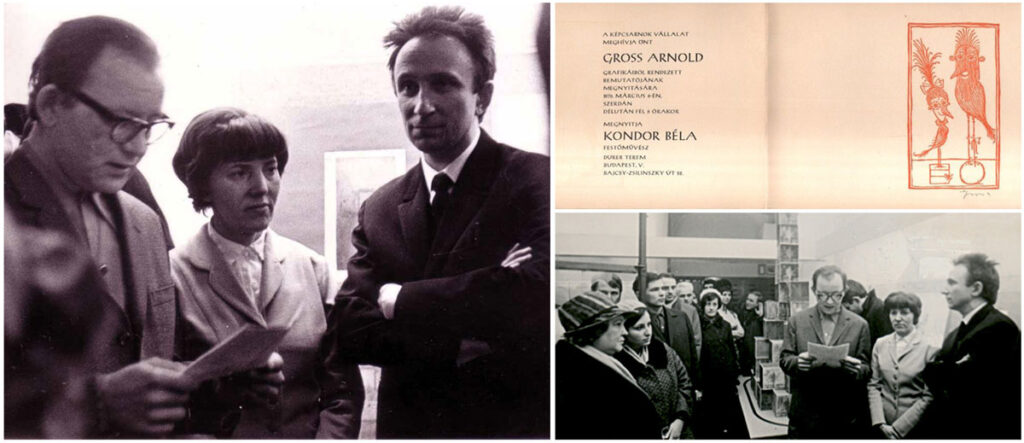
I do not know how closely he followed what I was doing, but the fact that in March 1970 he opened my graphic exhibition at the then Dürer Gallery — even though, as far as I know, he never otherwise undertook such a thing — perhaps shows that he found what I do interesting. In his opening speech he said: “There is far less peace in me — though it would be good if there were more — and less hopefulness than in Arnold; that is also why I enjoyed each new yet familiar-seeming work of his: they cured my bad moods at once.”
Béla Kondor opening Gross Arnold’s exhibition, Dürer Hall, 1970
What was Béla Kondor like as a person?
He lived amid great inner struggles and contradictions — between extraordinary heights and constant encounters with human frailty. The gulf between his longing for the true, the pure, the humane and his actual life deepened steadily, and this led to his sad tragedy. I first knew him as a pure, childlike, honest, blue-eyed student, and that is the image of him I keep within me.
In your opinion, was Kondor a symbolic painter and a metaphysical thinker?
His range of symbols was many-layered. He drew on several sources, but perhaps the greatest part came from the world of Christian thought. In many of his works he was preoccupied with the crucified Christ, which he interpreted and applied with great subtlety. He expressed his sense of life through this most tragic situation of Jesus’s life.
Perhaps he was not religious in the everyday sense of the word — Catholic, Christian; he is hard to fit into such categories. Did he want to be? Did he, having lost his faith, long for faith? Perhaps it was this longing that wore him down. He saw himself as bad, yet the religious person’s consciousness of self and of purity irritated him. He saw the world as bad too, and yet the imperative of restoring the moral order of the world pressed upon him.
In its day, Vigilia put questions to him as well about Christ, yet he answered rather with the swagger of an outsider. This ambivalence showed itself in his friendship with János Pilinszky too. That passionate friendship had already broken off before Béla’s death.
After his death I spoke with Pilinszky several times. Kondor’s death touched him very deeply; it pained him greatly. The break had deeply saddened Kondor as well. In that period many difficulties had accumulated in Pilinszky’s private life, and he suffered defining tragedies; perhaps that too explains his behavior. And perhaps it was their differing cast of soul — in the loftiness of his longings and the depths of his soul, Kondor could be a companion to Pilinszky. He himself put it into words in one of his poems: “Then I shall amble along beside you: / You, with shining face, pity me and love me.”
What do you think is the reason that, in a significant part of his oeuvre, various biblical figures and angelic and demonic creatures occupy an important place alongside Christ?
Kondor created a distinctive world of his own. He reinterpreted these universal symbols and applied them according to his own world view. Christian symbolism was thus most often coupled, in his work, with other symbols of a profane iconography. In his pictures he painted the vision of our age’s machine world, the duel of Good and Evil; in his visions swelling to cosmic scale, the corpus regularly appears — the divine, incarnated anew in every age. The suffering God and the crucified of the profane world bring, through their suffering, moral value into the worldwide destruction. In Kondor’s world, which longed to “leave a mark,” Christ rises to become the central symbol. In his volume of poetry and in his visual art he presents his world view on the same level. For me, his winged angels are Béla’s most endearing works. With him, the angels often accompany a resolution, counterpointing the tensions within the picture. Alongside the winged angel, the “monster-bird” of destruction, devastation itself, also appears in his pictures.
Gross Arnold: Béla Kondor Memorial Print (Kondor Béla emléklap) – etching, 1973
Can you name an experience that had a great influence on your artistic development?
I too came to believe that in life the insignificant and the meaningless things ultimately come together to form the great symbols of our lives. In contemporary art, it was in the moving image that I found the world view that had a defining power for me. I am speaking of Vittorio De Sica’s film “Miracle in Milan.” For me, this film was about love. In a poetic way, with angels and various other props, it holds up a pure, humane world of a kind rarely found in the visual art of the twentieth century. It became a defining experience of my life, one I believe I have managed to carry over into my works. I have seen it close to seventy times.
In conversations like this, the interviewer usually feels obliged to press the artist about his ars poetica. So that is what I shall do now.
The doctor, with his medicines and his intent to make things better, takes an oath to help and to heal people. In the visual arts, the artist must do the same by holding up the beauties, values and positive sides of life. I have remained in awe of Jan van Eyck and the great masters like him, and I am not ashamed to say that it is rather their world and their craftsmanship that I try to preserve. On the other hand, I am also marked by the professional ethos of the turn-of-the-century artisan. The shoemaker who knows his trade makes the shoe to suit the customer’s comfort, with the intention that the object should last, and with an eye to its beauty. In art, beauty is the most important thing for me. Without an audience, art does not fulfill its function of artistic communication. For me, the morally corrosive world called contemporary art does not belong to the category of art. It can largely be classed only as a tendency formed to abolish art. I feel that in our inhuman and anti-human age it is man who must be depicted; only thus will art be capable of holding up humanity as well. Non-figurative art abolishes creative existence; figuration creates room for the unfolding of the humane. Since art, in individual works, is the projection of the collective unconscious, it is the responsibility of the visual arts to summon forth the creative energies of the spirit of the age with the intention not of destruction but of betterment.
Finally, how would you sum up the place of man and of art in today’s world?
Man, as we know, is but a speck of dust in the universe. But just as the sun shines through a speck of dust and makes it sparkle, so the whole universe shines through man.
JÚLIA KOSIK – VIGILIA 1995/8