
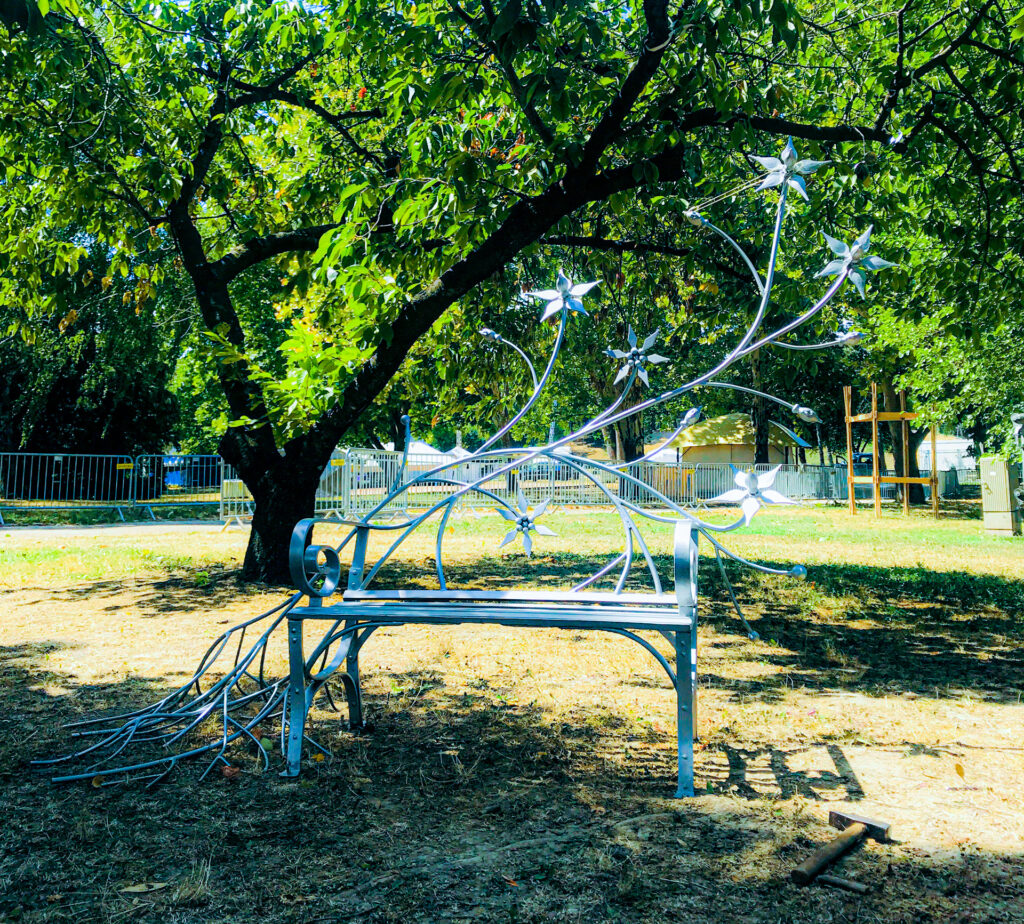
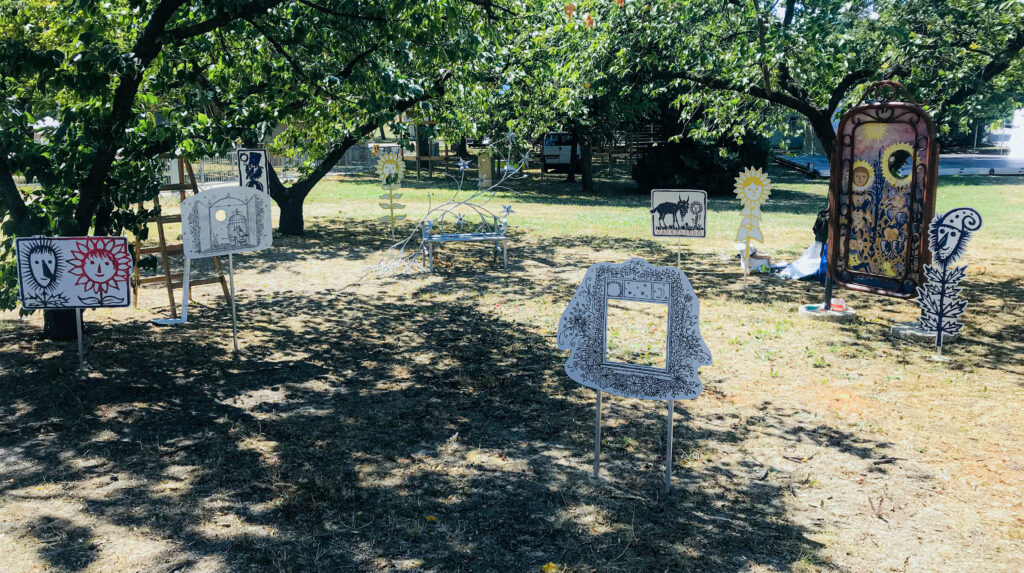
The Enchanted Forest is the site-specific installation of the Sziget Festival. Commissioned by the Gross Arnold Gallery, the artist duo Katalin and Paul Kortmann designed and built an installation for the Artgarden venue: a bench overgrown with tall, symbolic flowers and concrete heads — a small island of retreat, escape, and rest, which also makes an excellent selfie point, through which the human face becomes a fixed part of the installation. The bench stands in a small grove with a curious mirror frame — a paraphrase of one of Gross’s pictures, which is at the same time a fairground attraction device — and under the spell of the strange reflective ornaments covering the surrounding trees, the visitor finds themselves inside a Gross Arnold world.
Katalin Kortmann Járay (1986, Budapest) and Karina Mendreczky (1988, Budapest) have been working closely together as an artist duo since 2019, creating large-scale, walk-through installations from a spatial collage of various elements. Their joint works combine different techniques and materials to create their metaphorically feminine spaces, typically incorporating textiles, photographs, and sculptures made of iron, clay, or porcelain. In 2023 they were jointly awarded the Esterházy Art Award.
Paul Kortmann, the contractor who assembled and welded the iron elements appearing in the duo’s previous installations, is present in this installation as a participant in a creative capacity. In this way, the bench can be seen as a new cooperation between the contractor and the design duo.
The theme of the installation designed for the Sziget Festival evokes the spirit of the Gross Arnold world. Its central element is a bench with a welded, towering arrangement of iron flowers and plants (elements between 1 and 2 meters tall) rising from its iron framework, which appear partly as schematic elements lifted from urban architectural ornamentation and partly as photo-based likenesses of the natural elements that inspired the plant ornamentation itself. It is into this scene that the visitor steps: the Gross Arnold flower symbolism and the animistic flower-face motif, often used by the artist duo as well, are embodied here by the visitors/viewers themselves as they sit down, thereby lending their own faces to the plant environment. The ornamentation composed of two- and three-dimensional elements and the photo-based parts, completed by the living participant, appear and form a whole as a gradually schematizing, transforming extended collage.
Structure: the bench’s supporting structure is assembled from bent iron elements, onto which the cylindrical and round iron bars, bent to shape, are welded to form the stems of the plants. Some of the flower heads are assembled from collected antique and cast-iron fence elements.
Figures printed on large alu-dibond panels, enlarged drawings, and a curious mirror — brought to life by the Gross Arnold Gallery — further populate the atmospheric enchanted forest, bringing the lovely two-dimensional works of the artist Gross Arnold (1929–2015) to life on a larger scale and connecting them with today’s young festival-goers. The other central element of the installation is an artwork created by restoring an old Thonet mirror frame and marrying it with one of Gross’s curious sunflower paintings. The sculpture-like object standing freely in the space, along with the other elements of the installation, was made by the artist’s son, Gross András, by extending and respectfully rethinking his father’s works — and in this way the transgenerational creative work was realized not only in theory but in reality. The more than 80-year-old bentwood frame and, around it, the drawings from 60 years ago in large format — in a completely new location, at a festival, in a lovely grove, far from the sterile world of exhibition spaces — present in a new context the shared theory of several generations of artists: the importance of harmony between nature and humankind.